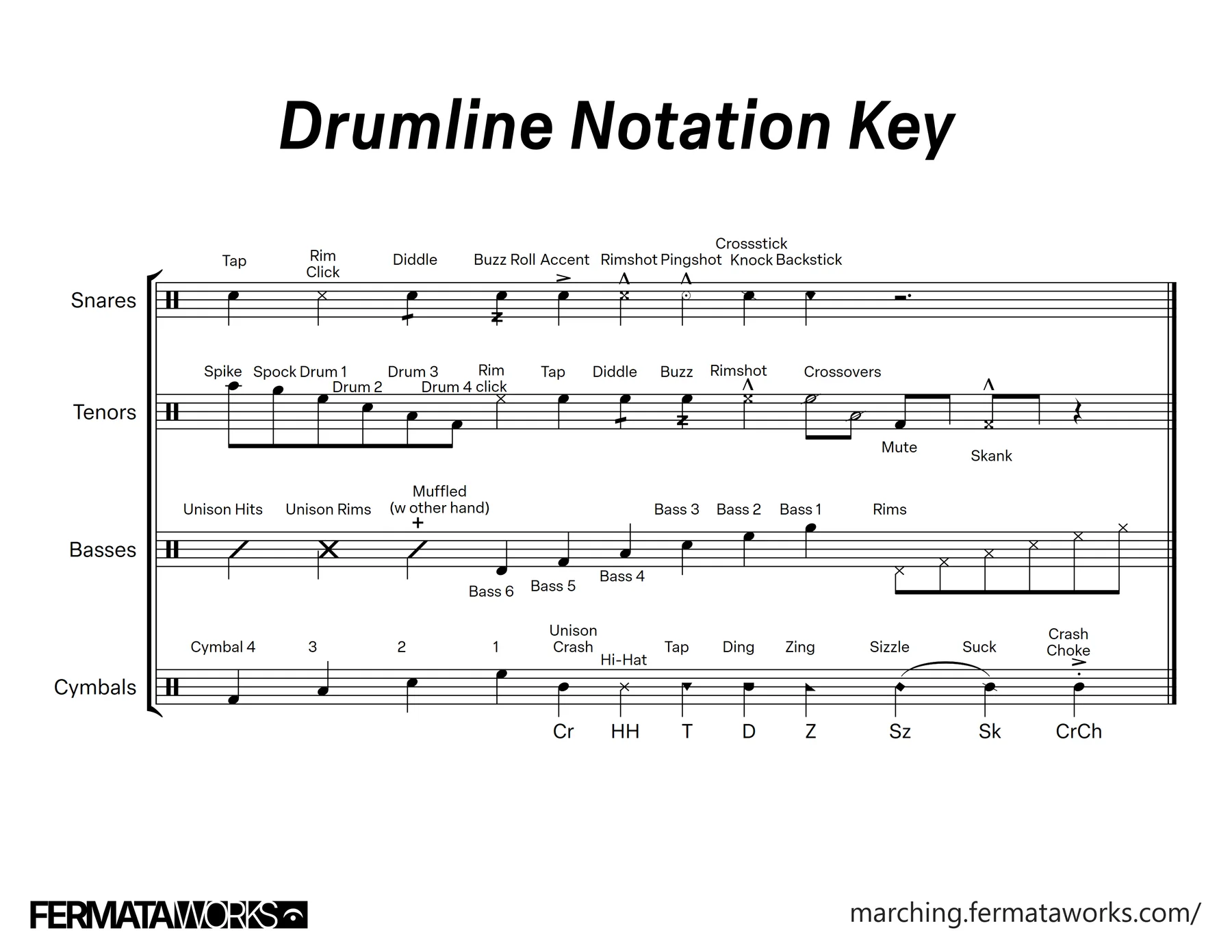
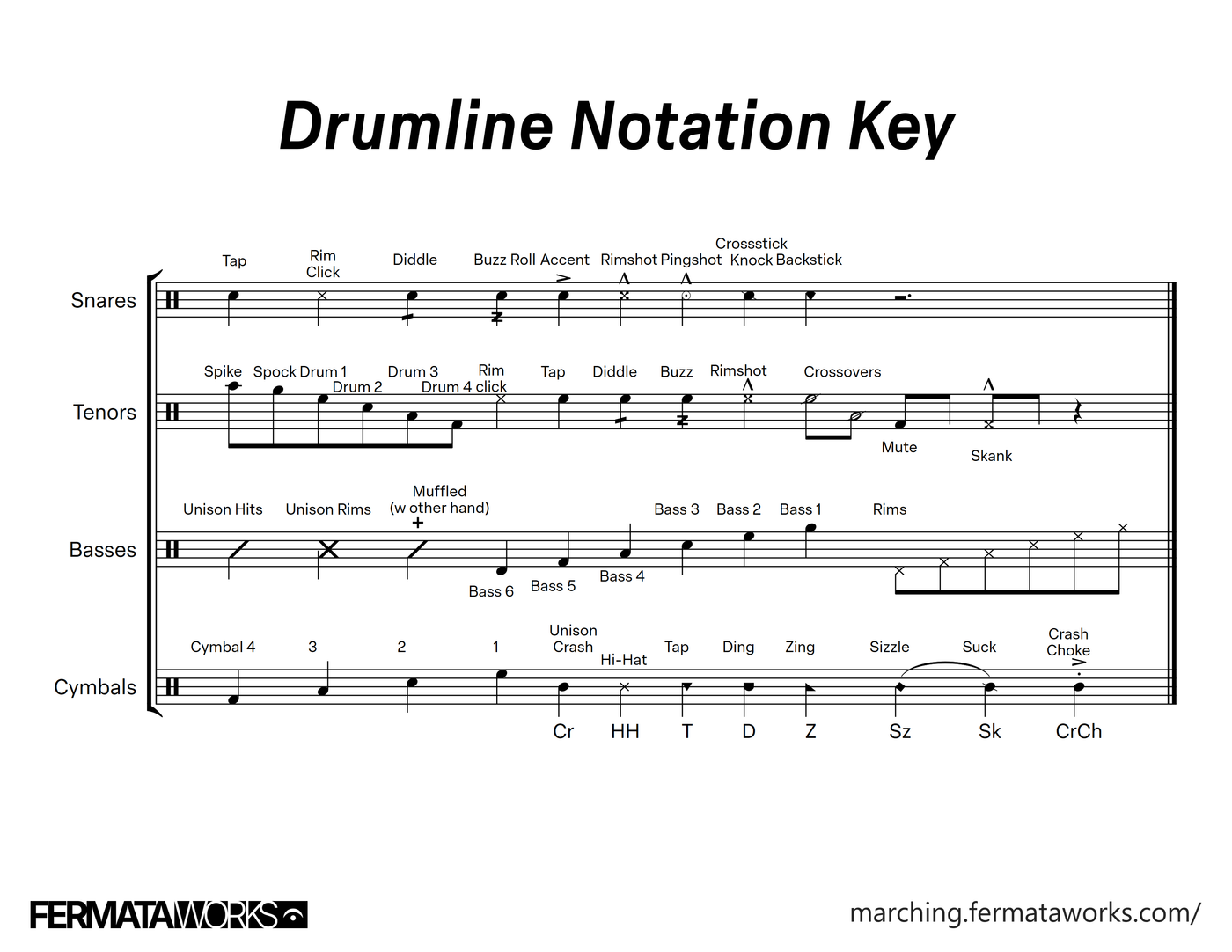
In drumline, each instrument has their own rules for how notation is written. Fermata Works uses a standard that we think works well for both our writing flow and our student's reading.
Snare
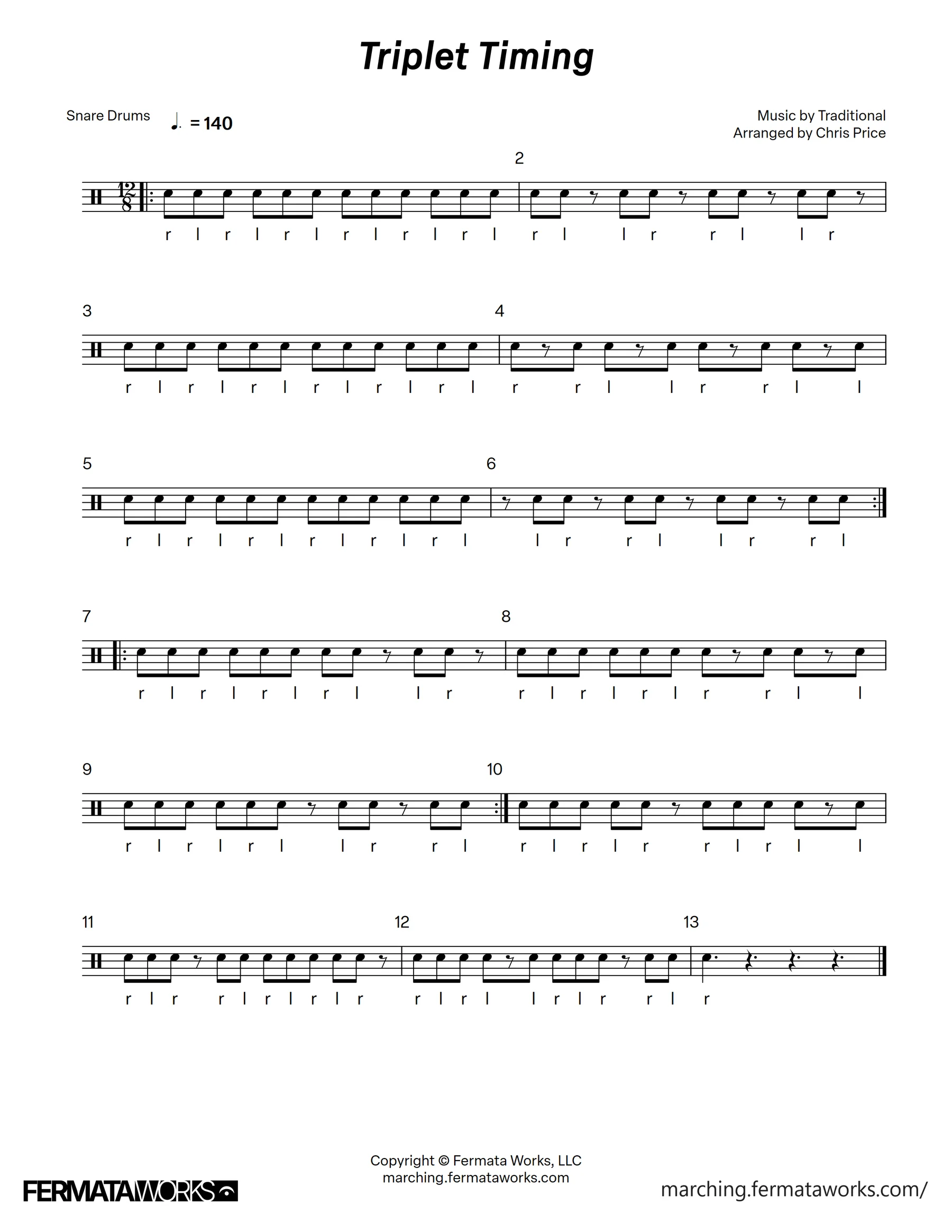
A tap is notated with the basic notehead. When that notehead has an accent above it, it's changed to an accent. Accents and taps are one of the most fundamental parts about drumline playing, so use them often. Diddles are written with one singular slash through the stem. A diddle is when you take the note value, cut it in half, and play it again, on the same stick. For example, eighth notes with slashes in it would turn into sixteenth notes, with the player playing r r l l r r l l sticking. A buzz roll is notated with a Z on the stem. Those are several bounces with a single stroke, giving a "buzz" sound. Rim clicks are notated with an X notehead. With you add a marcato to the X notehead, you get a rimshot. There's another type of rim shot called a pingshot, which is notated as an open circle with a dot in the center. A notehead with a slash through it is a crosstick knock and a diamond shape notehead is a backstick.
Tenors
Most of tenor notation is borrowed from snare notation, such as taps, accents, rimshots, diddles and buzz rolls. Different lines and spaces mean different notes. Notice how although the pitches of the drums are in order, it's not physically in order left to right, keep that in mind when writing. Crossovers are notated as an open notehead with a slash through it. Mutes and skanks are both invisible noteheads.
Basses
Basses, like tenors, are written so that each drum has their own space. Basses usually see all bass parts together to easily see where they fit. A giant slash notehead means unison, and a giant X means unison rims. A plus means the hand not playing the instrument will muffle the drum.
Cymbals
Cymbals are by far the most complicated notation-wise, and the least agreed upon. Like tenors and basses, each space is assigned to a specific cymbal, with center line being unison. Regular noteheads are crashes, X noteheads are Hi-Hats, Triangle noteheads are taps, square noteheads with bottom two corners rounded are dings, right triangles are zings, diamond noteheads are sizzles, noteheads with a slash through them are sucks, and staccatos always mean choke.
Things to Think About
Although drumline is getting more and more standardized, there's still discrepancies from publisher to publisher. This is how Fermata Works writes drumline parts and how many others do as well. At Fermata Works, we value writing music that's accessible, so we won't go out of our way reinventing the wheel for drumline notation.