Last week I was driving to the gym with my wife while showing her a new show I was working on. The start of the show had crickets and other "swampy" sounds to set the mood of the show. She then asked me, "how are you supposed to get the students to make the cricket sounds?" I then spent the next 20 minutes explaining synthesizers, samples, mainstage, electronics and their history in marching band shows instead of the simple answer, "It's coming from a synthesizer."
Sound design and synthesizers are something very near and dear to me as my first instrument in marching band was a synthesizer and music synthesis was one of my main focuses in college. It was fun being able to play notes on the keyboard and support the entire band with strings, a piano, or any other sound that was needed. However, what I did on synthesizer is much different than what's now common for marching band shows.
In marching band, sound design is the creative process of developing and integrating electronic, sampled, recorded, and processed sounds into a production. This can include everything from atmospheric sound effects and synthesizer patches to vocal samples, musical transitions, and effects that enhance the overall sound of the ensemble.
History of Synth and Sound Design
Marching band rules and designs are often downstream of whatever is happening with drum corps. Sound design is especially based on what was happening in DCI.
For the longest time in the marching arts, using audio from anything outside of the acoustic instruments on the field was seen as cheating. One of the first cases of an ensemble using a synthesizer during a field show was Boston Crusaders 1985, who used the Beverly Hills Cop song "Axel F." They got a penalty for using the synthesizer but stuck with their decision so they could get the exact sound they wanted in their show design. For the next 24 years, synthesizers would remain prohibited in DCI competition, although their use in high school marching bands varied depending on the circuit.
In 2004 DCI allowed amplifications of acoustic instruments, making it common for soloists, front ensemble, and other sections to be amplified through microphones. During this time, synthesizers were still not allowed.
2009 was the big turning point when synthesizers, mixers, and other electronic instruments were allowed. This was when the sound wars of marching really started. Ensembles would try to introduce new methods of adding audio samples, synth patches, and other unique sounds into their shows to give them a leg up. Amplification would also become more common, going from just soloists to field mics, making it so the entire ensemble would be amplified easily. Still to this day, many people will argue whether or not this is unfair to other ensembles who can't do this.
In 2014, Bluecoats took sound design to another level with their show "Tilt." While synthesizers and electronic effects had already been used in drum corps for years, Tilt demonstrated just how integral electronics could become to a show's identity. Its famous pitch bend became one of the most recognizable moments in modern drum corps history, helping establish sound design as a major creative component of contemporary marching productions.
How Sound Design is Made
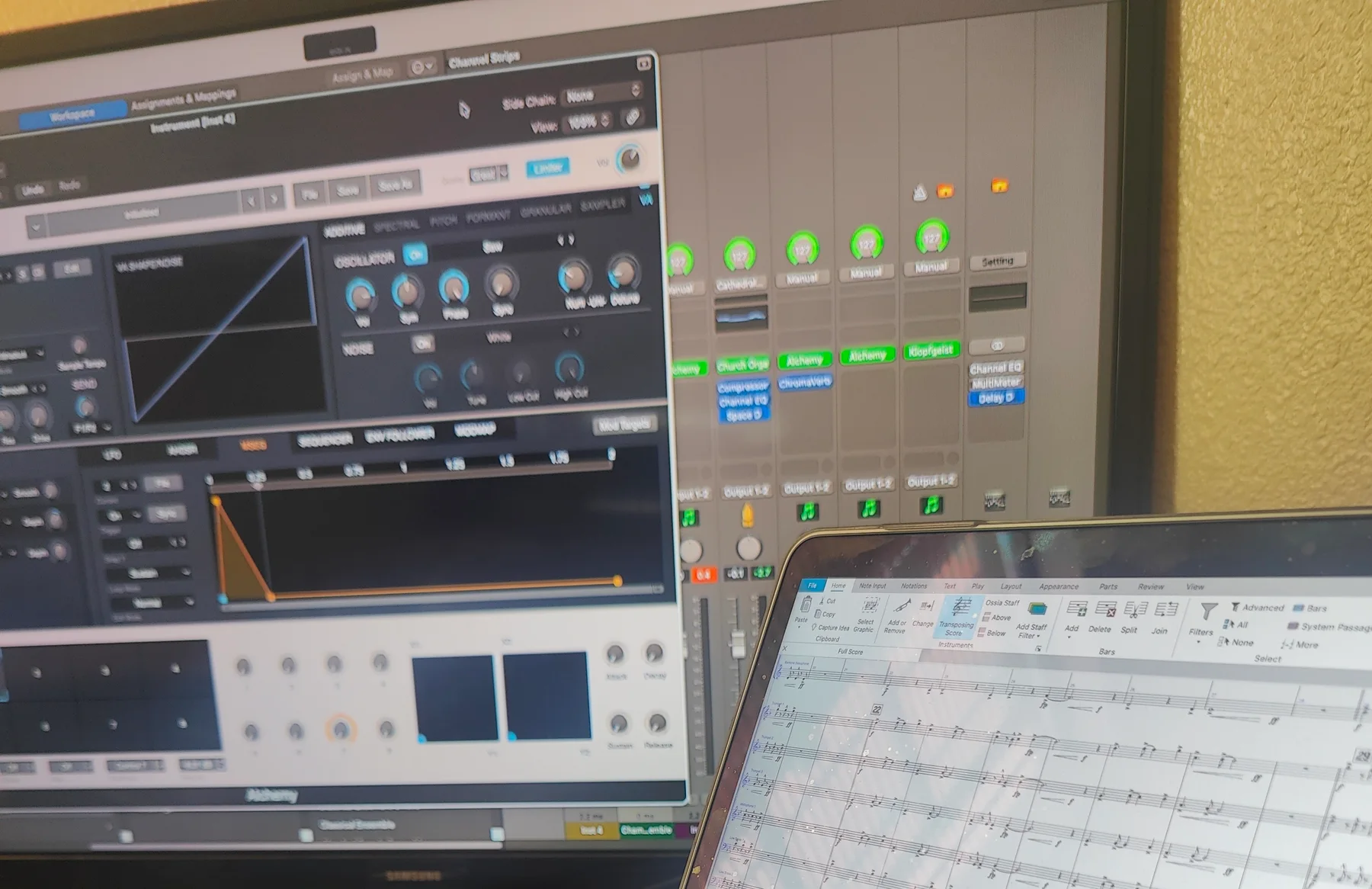
Sound design used to simply be the default stock patches that would come with a synthesizer, such as piano, strings, harpsichord, choir, etc. Now, synthesizers are often midi controllers, sending midi data to a computer, in which the sounds come from the computer itself. Macs are a popular choice of computer because of the program, Mainstage. Other options such as Ableton live, FL Studio, Reaper and more are used, but because Fermata Works specializes in Mainstage, we'll mainly talk about it. Mainstage allows for the creation of extremely detailed custom patches, allowing for music synthesis, sample playback, high quality effects, and more. A sound designer can create a patch, set one key to play a sound, a range of keys to play a violin, and the mod wheel to control reverb. This makes it so the synth player is more than just a glorified sample player, making their job actually be musical and part of the ensemble.
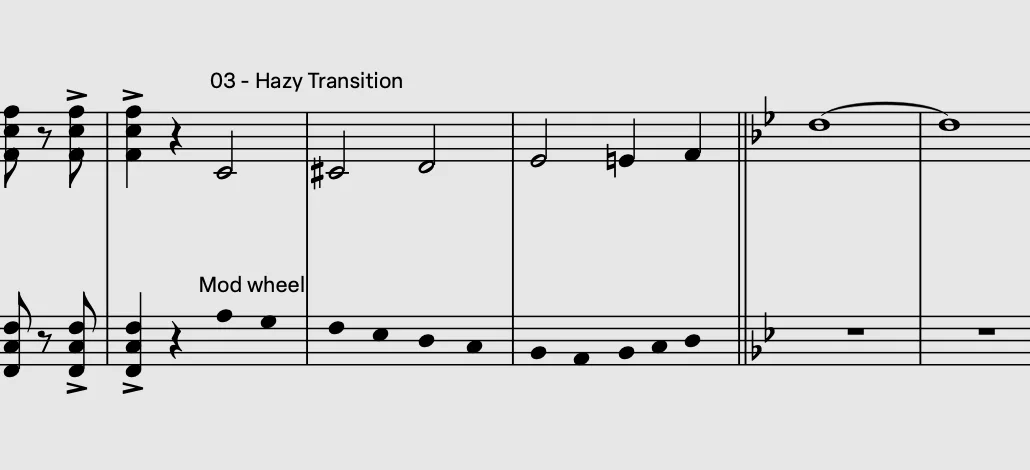
Once the Mainstage file is created, the performer will get sheet music that reads like a piano book, however will have extra information, telling them which patches to play, showing mod wheel information, and sometimes have markings about what specific samples the notes are playing. Below is an example.
The audio is routed from the midi keyboard, to Mainstage (or other programs), then to a mixing board, and finally to speakers that send the audio to the audience.
From the smallest cricket chirp to the largest electronic impact, sound design gives us another way to tell a story through music. When Fermata Works does sound design, we have it hooked up to Sibelius so we have instant playback of our patches based on what the sheet music is playing. This allows us to have sound design as a constant thought and not something placed after creation.
If you're looking for a high quality show or just need sound design for your show, contact us and we'll be happy to meet your ensemble's needs!



Comments
No comments yet.
Sign in to join the conversation.
Login to post a comment