When I was a young composer I found it very annoying to have to write for viola. I was a pianist and had a good grasp on treble clef and bass clef. Viola was written in alto clef and made absolutely no sense to me. now imagine my shock when I learned that woodwinds and brass instruments were written in different keys. Although many types of instruments have their strange notation quirks, nothing is stranger than percussion notation.
Percussion Notation Is Rhythm First
Percussion has no universal standard, and that's for all percussion, not just drumline. This is due to a few factors, including each percussion instrument having several different techniques and effects, styles developing independently, and western music having no governing body for notation.
When a violinist sits down to play their part in an orchestra, they're playing one instrument, with instrument itself and notation being relatively unchanged for the last 400 years, same strings, same tuning, same notes. When a percussionist sits down to play in an orchestra, they're often playing several instruments, each with different techniques. For example, a tambourine roll can be done in several different ways based on the musical style and dynamics. With their being no governing body of music, composers will choose different ways to notate the same technique.
Percussion also developed independently in different areas around the world. Orchestral percussion often emphasizes instrument selection, dynamics, and playing techniques. Pipe band drumming has a strong emphasis on rudiments, sticking, and ornamentation. Marching percussion emphasizes sticking, accents, rudiments, drum placement, and specialized effects.
Although percussion is notated in several different ways, the notation is meant to serve one purpose: conveying rhythmic information.
The Snare
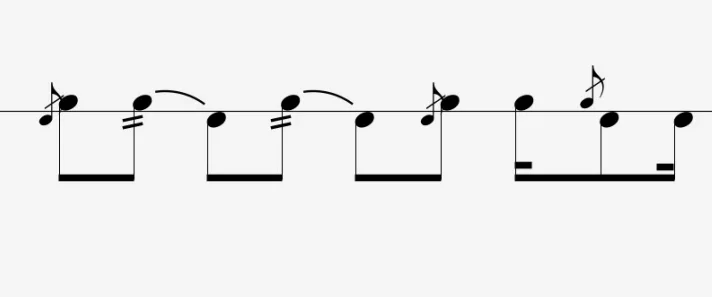
Snare drum in pipe bands are often notated as one line, with the notes either on top or below the lines, the top representing the right hand and the bottom representing the left. Pipe drumming usually relies on the performer knowing the style, leaving out dynamics, rimshots, and other special effects. If you look at pipe band snare music you'll see that ornamentation and rudiments are very present. Also mathematically some rudiments do not line up. Below you'll see a flam followed by an eighth note with two slashes and then another eighth note. One may see it as a flam followed by a five stroke roll (two slashes turns one note into 4). However, the sticking changes from right to left, making a five stroke roll not work. The notation is actually showing a seven stroke roll after the flam, which with one may not be able to figure out simply by looking at the music unless they've been taught pipe drumming before.
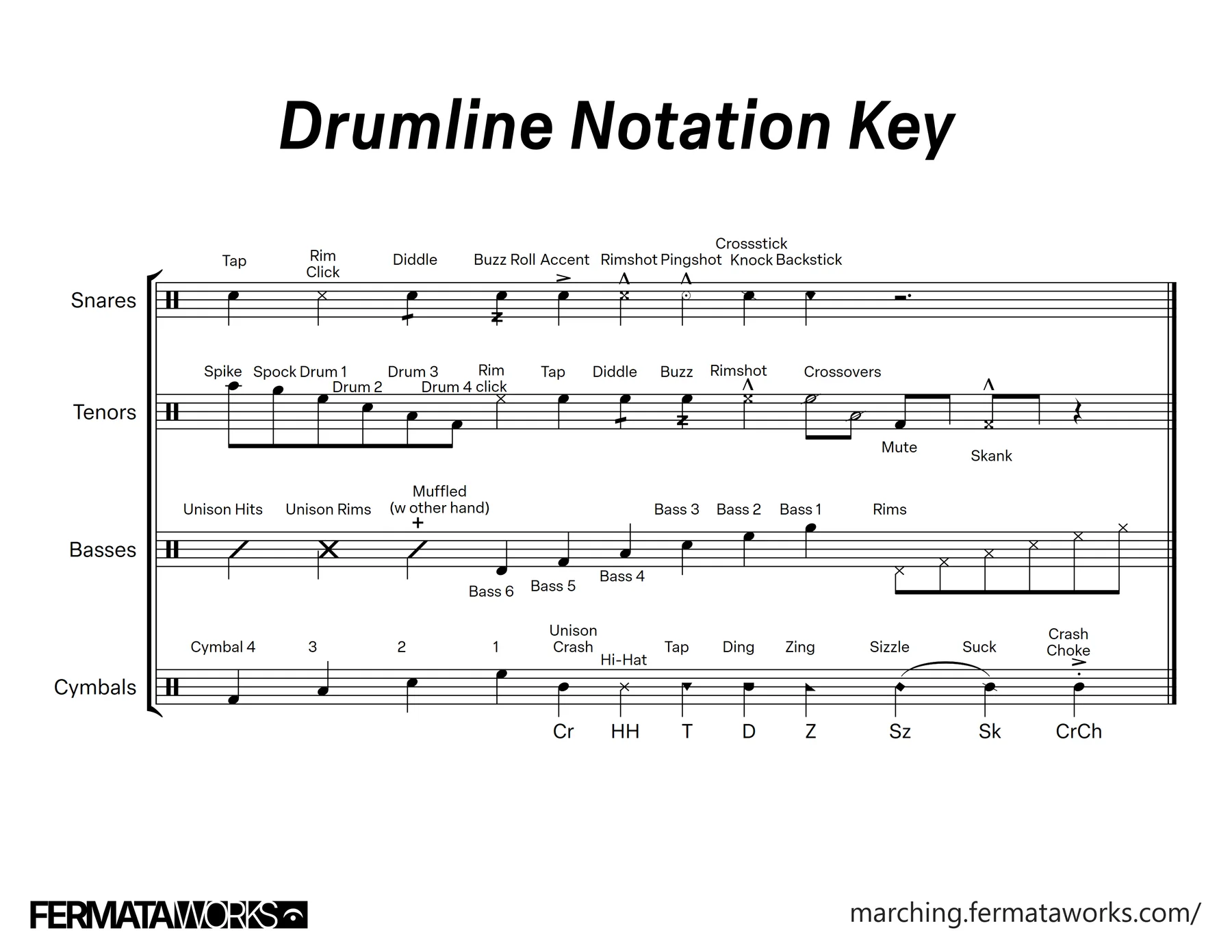
Marching band type notation for snare often uses 5 lines with the placement of the note varying depending on the engraver. A common standard that's seen throughout the marching arts community, and what Fermata Works uses, is the third space from the bottom, or "C" if it were treble clef. Then underneath, sticking is written, R for right hand, and L for lefthand. Some engravers, including us at Fermata Works, notate taps with lowercase letters and accents with uppercase letters, making a paradiddle shown as Rlrr. We believe this makes the music easier to read.
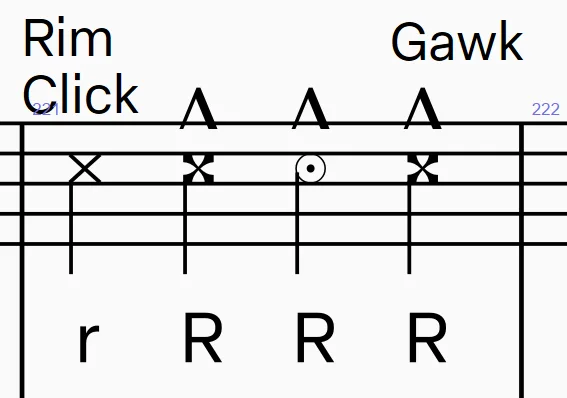
With the five line staff, it allows arrangers to add more effects and playing styles that one line would make difficult. Sometimes accessories are attached to the snare, making it so another space could be mapped to the accessory. For rim clicks, oftentimes an X is shown as the notehead in either the same spot as the normal snare notation or another line. As an arranger, it's important to add text to above the staff when a style is changed, at least for the first time. Rimshots are either shown with just a marcato over the note, or an X with a marcato over it. At Fermata Works we like using an X that has a non-uniform stroke on the lines, as well as a marcato over the note. For ping shots we use an open circle with a dot in the middle. If the shot type is a gock, we simply write "gawk" or "gock" over the rimshot.
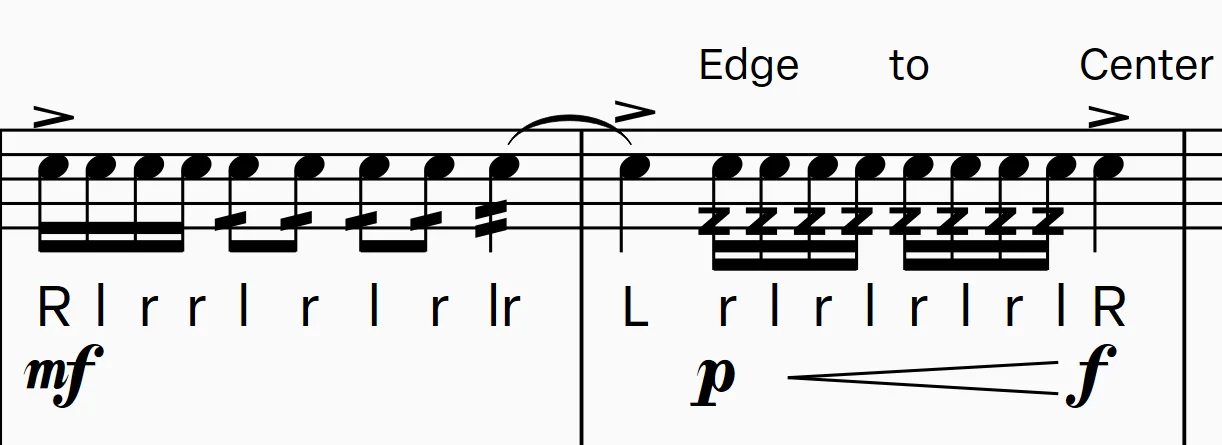
In marching music the performer will also often see diddles in their music. Diddles can either be written as two notes with the same sticking or one note with a single slash line in the stem. We at Fermata Works perfer a single note with a line through the stem, that way the diddle can be taken away to practice the skeleton. When you start adding more slashes you enter into 5 stroke, 7 stroke, 9 stroke etc rolls. For buzz rolls, they are simply notated with a Z on the stem. As an arranger, it's a good idea to make rudiments very obvious. The performer should know if they're playing a set of diddles or a paradiddle. Below is an example of a paradiddle, a set of diddles, a five stroke, then some buzz rolls
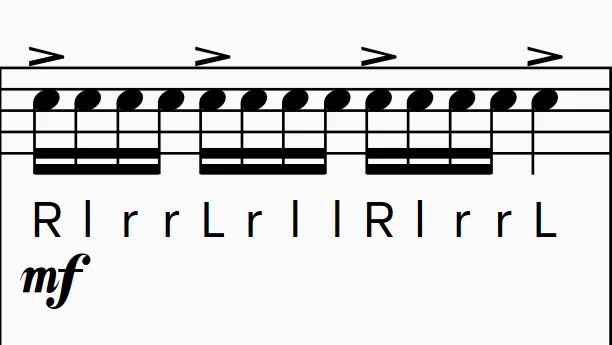
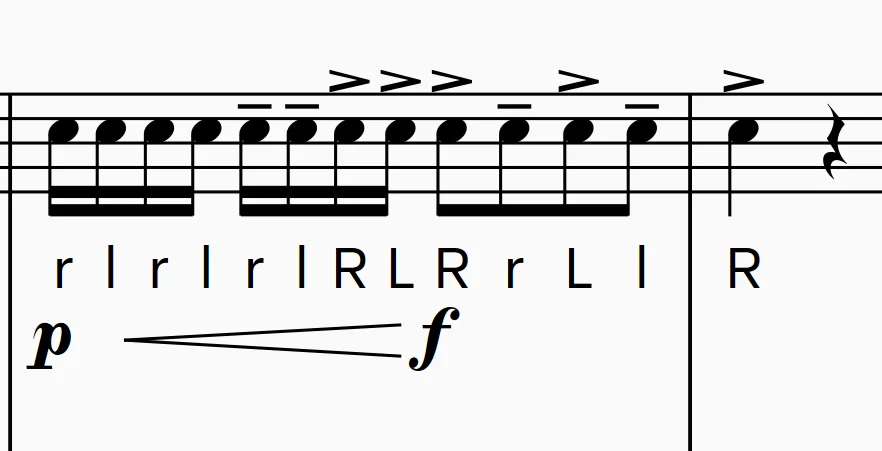
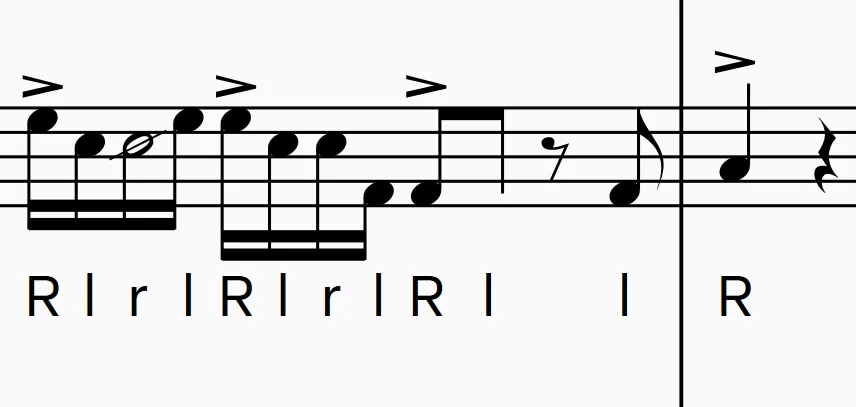
Another marking that's seen very often and not as talked about is the tenuto mark. In marching percussion, a tenuto mark can mean one of a few things depending on its context: More weight to the note, halfway from a tap to an accent, or a tap on the same sticking after an accent. At Fermata Works we call these agogic accents, and use it to indicate halfway from a tap to an accent and also a tap on the same sticking after an accent. Example below.
One last thought before we move on. Sometimes arrangers add Flub drums to their scores. They are often notated the exact same as Snare, only with easier music.
Tenors
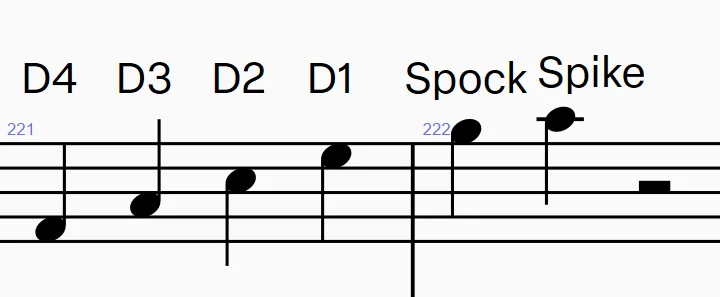
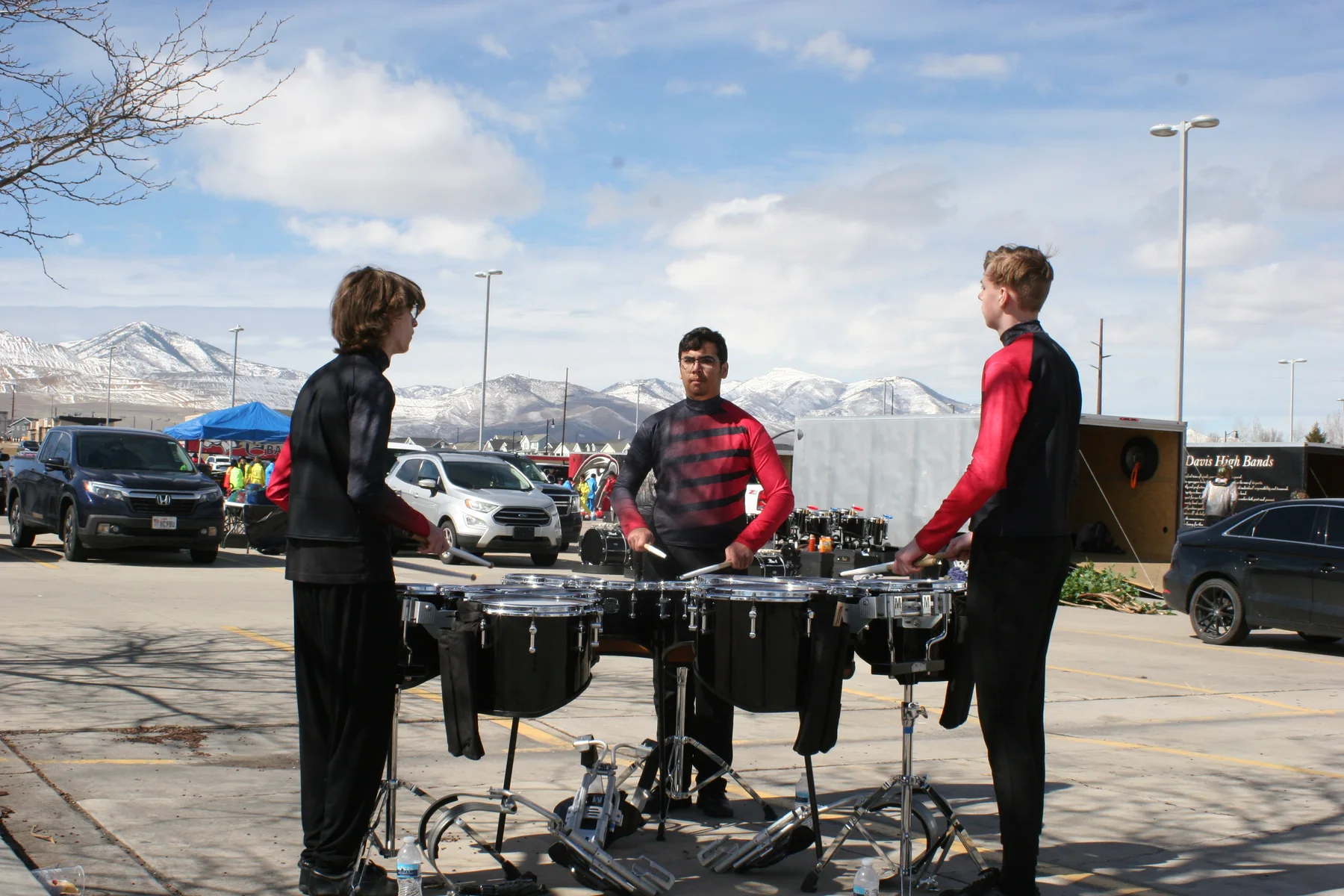
Tenors, quads or quints, are some of my favorite drums to write for due to how melodic they can be. Rather than describe where each drum lies on the staff, I think it would be better to just show you. Below is the map of where drums land on tenors.
Notice how I put "Spike" for the highest drum. That's what some percussionists call the higher spock drum when there's 2 spocks instead of 1. Just like the snare, many ideas translate here as far as noteheads and ornamentations. Slashes indicate rolls and diddles, Z indicates buzzes, rimshots are the X with a marcato and sticking is R and L, respectively. However, I would advise to note add pings nor gocks. By default, tenor drums should have rimshots as ping shots, so putting a normal rimshot notation should be enough for the performer to know it's a ping shot. Gock shots get a "dead" sounding effect that doesn't work well on the tenors.
Tenors also have 2 more unique styles that other drums don't include as often. Muting and crossovers. Muting is simply when the performer uses a hand to mute the drum after it's been struck. Some arrangers write "mute" over the note, and sometimes you'll see what we at Fermata Works like to do, use an invisible notehead with the sticking (I guess the hand) below it. This allows for more control on when the drum is muted. For crossovers, there are three common ways to notate crossovers, the note around parenthesis, the notehead open, or the notehead open with a slash running through it. At Fermata Works we like the open notehead with a slash. Example of both below.
Bass Drums
Bass drums are my favorite to watch when executed well. I to this day do not understand how some basslines are able to split the way they do. Bass drums, unlike other marching percussion drums, usually only have a few sounds they can produce, accents, taps, and rim clicks. There's a few other sounds they can make, but those are pretty rare and I won't be writing about them in this blog.
A bassline is usually 2-6 bass drums, with them all sharing one staff. Each drum gets their own space on the staff, going in order of lowest to highest. At Fermata Works we often write with 5 bass drums with the bottom space being drum 5, the lowest drum. The center line is for when all drums are playing together in unison, often notated with a notehead that's a long slash. Some arrangers add sticking for every single note, but at Fermata Works, we only include sticking when notes are unison.
Cymbals
This section is mainly going over how Fermata Works writes cymbals. Other arrangers use this same technique but it is not the universal standard.
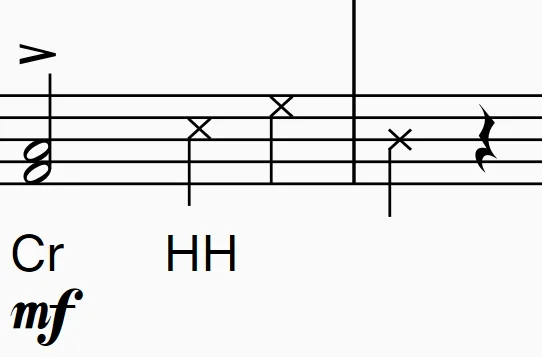
Cymbals are some of the most in depth marching percussion instruments because of how many different sounds one can make with them. Just like bass drums cymbals are often in a line of multiple performers, often 2-4. Some lines, like the Boise Gems, field 6! Cymbals are probably the instrument with the most debate on notation style. At Fermata Works we are trying to be the ones to set a good standard in cymbal notation and pull from ideas of the bassline to make it as easy as possible to read. Each space is a single cymbal and the center line is unison.
Because cymbals don't have individual pitches like bass drum, it's imperative to tell the cymbal players which cymbal player they are and which space they read. At Fermata Works we refer the top space as cymbal 1 and the bottom as cymbal 4.
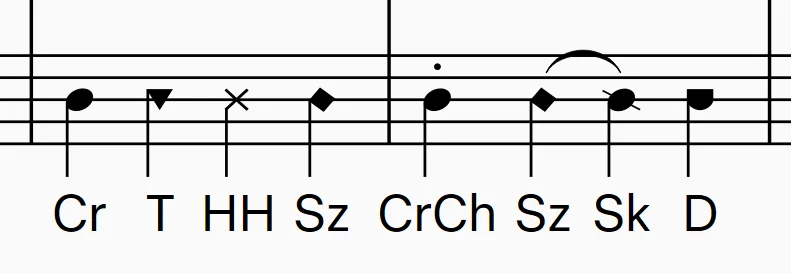
There are several different techniques to playing the cymbals. In this blog I'll go over the most common ones and how they're notated by as at Fermata Works. The crash is a normal notehead with "Cr" written under it. A tap is a triangle notehead with "Tp" written under it. A ding is a square notehead with the bottom corners rounded with a "D" written under it. A sizzle is notated with a diamond notehead and "Sz" under it, which is sometimes followed by a suck, notated as a notehead with a slash through it and an "Sk" underneath it. Sizzles with a suck after are always slurred. Hi hat is an X notehead with "HH" written under it. If a note ever needs to choke "Ch" is added under it. Zing is a triangle with a "Z" below the note. Below is an example.
At Fermata Works we only write the technique under the first note after a change.
Final Thoughts
Marching percussion is far from being standardized but also far from needing a Rosetta stone to understand. At Fermata Works we believe it's important to have good readable music. If you need custom readable music for your ensemble, contact us for a quality show written for your ensemble.



Comments
No comments yet.
Sign in to join the conversation.
Login to post a comment